
You can read this for free... Or join others who have paid it forward over the last 15 years to keep the site ad-free, the content coming and the coffee flowing.
Thank you,
Emily
Pick your favorite way to send a little love <3
CashApp: $MissEmilyPatterson
venmo: @MissEmilyPatterson
PayPal: Log in or scroll to bottom of PayPal transaction page and click "Pay with Debit or Credit Card"
|
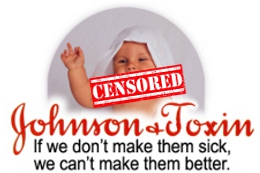
Johnson and Toxin, Er, Johnson & Johnson. Hm, Think I Had it Right the First Time
Carcinogenic contaminants, carcinogens, allergens, potential neurological damage, bribery, class action lawsuits and recalls. Maybe it's time to stop giving Johnson and Johnson our money to pay their fines?
Date Created: 2011, October 28
Keywords: carcinogen, baby, shampoo, dermatitis, cancer, allergen, asthma, eczema
This page accessed 5,206 times.

You can read this for free... Or join others who have paid it forward over the last 15 years to keep the site ad-free, the content coming and the coffee flowing.
Thank you,
Emily
Pick your favorite way to send a little love <3
CashApp: $MissEmilyPatterson
venmo: @MissEmilyPatterson
PayPal: Log in or scroll to bottom of PayPal transaction page and click "Pay with Debit or Credit Card"
|
Johnson & Johnson has three facets to their company: body 'care' products, medical diagnostic equipment and pharmaceuticals. This represents an extreme conflict of interest when considering they have the power, and obviously the lack of ethics, to cause disease with their products, diagnose the diseases they caused with their body 'care' products with their diagnostics products, and then treat the diseases their body 'care' products caused with their pharmaceutical products. I have a problem with *all* companies that include risky chemicals in consumer goods, however, Johnson and Johnson wins the "Lack of Ethics" award of the highest standing by combining harm with the perception of improving health and caring - when all they really care about is their, not your child's, bottom line.
In April of 2011, Johnson and Johnson agreed to a $70 million settlement for criminal charges to the Justice Department and Disgorgement and Interest to the Securities Exchange for bribery, according to the
Huffington Post. Johnson and Johnson bribed officials and doctors in Greece, Romania, Poland and Iraq for preferential treatment of their pharmaceutical products. This was a trusted company for over 100 years. In addition to lacking ethics in their business dealings, they also lack ethics in the chemicals they choose to use in their products.
There are many questionable, and flat out toxic, ingredients in Johnson and Johnson baby care products. While the focus of this article is specifically Johnson and Johnson, other well-known brands also contain these ingredients and contaminants. The response from emails sent to Johnson and Johnson regarding their position on the toxins and toxic contaminants in their products earned the following response, "Johnson & Johnson Consumer Companies fully comply with regulations on ingredients in all countries in which our products are sold. Wherever regulatory authorities have set limits on certain ingredients, our product formulations exceed or meet those requirements. We are committed to maintaining the high standards of quality and safety that have been our hallmark for generations of consumers."
Inclusion of chemicals that have been tested and shown to pose a risk to our children should not be included in any baby care products for ethical reasons. If risks are shown by any studies, Johnson and Johnson should have the integrity to remove the potentially health-harming chemical from products intended for children immediately, rather than wait for regulatory restrictions.
Two of four of the parabens were outlawed in products intended for children under three in Denmark in December of 2010. The two banned parabens are propylparaben and butylparaben. While there is a lot of speculation that the endocrine disrupting hormonal effects of parabens is hazardous to human health, the risk is obviously enough to warrant a ban in products intended for children who, because of their small size, absorb a higher quantity per body weight than older children or adults. Both of these chemicals are included in many Johnson and Johnson products intended for babies and small children.
Methylchloroisothiazolinone/methylisothiazolinone are two common contact allergens used as a preservative in numerous body care products. This chemical may be responsible for eczema in small children. Patch testing will determine if your child is sensitive to this chemical preservative. In addition to the potential as a contact allergen, a new study shows that this chemical may be a neurotoxin. This study, "
Methylisothiazolinone, a neurotoxic biocide, disrupts the association of SRC family tyrosine kinases with focal adhesion kinase in developing cortical neurons.", summarizes, "
Prolonged exposure to low levels of MIT and related compounds may have damaging consequences to the developing nervous system."
Phthalate esters, used to preserve synthetic fragrances in body care products, are endocrine disrupters that mimic hormones in the body and are likely also responsible for the dramatic increase in asthma over the last 40 years. While numerous studies could be quoted, the one that really tells the whole story is this one,
Ginger suppresses phthalate ester-induced airway remodeling. in which inflammatory asthma was induced in human lung tissue with phthalate esters to study ginger as a prevention method for blocking the effects of exposure to phthalate esters. If the chemical is being used to induce asthma in human tissue to study treatments for humans, it should not be in any products, let alone products intended for small, developing children. You won't find 'phthalate' on the label, these chemicals are hidden under the term, 'Fragrance/Parfum' and considered proprietary information.
Propylene glycol ethers are considered volatile organic compounds, or VOC's, and are associated with an increased risk of asthma, allergic rhinitis and eczema. This study,
Common household chemicals and the allergy risks in pre-school age children., summarizes propylene glycol in bedroom air was associated with an increased risk of the above-mentioned conditions. This study was not done with a child soaking in a tub of bubble bath or having the chemical rubbed all over their skin and hair.
Sodium lauryl sulfate, a common detergent foaming agent, has been replaced in numerous products due to the potential for dermal irritation. However, sodium laureth sulfate is actually far worse. A by-product of the process used to create sodium laureth sulfate, 1,4-dioxane, is a known carcinogen. While this chemical can be removed during processing, many Johnson and Johnson baby care products tested positive for 1,4-dioxane in a study done in 2009. Products from a number of other companies were also contaminated with 1,4-dioxane. The contamination is not printed on the label as this is not an 'ingredient', it is a 'contaminant'.
After decades of known health risks from exposure to
formaldehyde, it was finally added to the EPA list of known carcinogens in the
12th Report on Carcinogens, published by the National Toxicology Program in June of 2011. It was added because it was finally accepted that formaldehyde increases the risk of leukemia, nasal cancer and nasopharyngeal cancer. However, formaldehyde remains in numerous consumer goods, including baby shampoo at rates hundreds of times higher than the threshold set by the EPA to be below the level for increased risk of developing cancer.
Chemical sterilization of talc with
ethylene oxide is banned in numerous countries around the world. The banned sterilization process leaves behind traces of
ethylene oxide, a proven potent carcinogen. On the tender and permeable skin of newborns, this chemical is absorbed and inhaled by the baby during application and dramatically increases the risk of the baby developing a variety of cancers later in life.
1,4-dioxane is a known dermal irritant that results in nasal cavity, liver and kidney damage.
As parents, we want what is best for our children. Products that contain risky chemicals and known carcinogens are not best for our babies. We need to know that the products we choose for our children are safe. The way things are now, we can't know what's in our products. In addition to what is on the label, according to The Washington Post article, "
Use of potentially harmful chemicals kept secret under law", we don't have to be told what's in our products, so how can we know what's safe? As parents, we need to research dependable, natural resources, at least for the care of our children.
If you found my work informative, join others who have paid it forward over the last 15 years to keep the site ad-free, the content coming and the coffee flowing.
Your contribution funds:
- Research
- Content Development
- Graphics Creation
- Site Maintenance
- Hosting and Mail Fees
- LOTS of Coffee
Any amount is very much appreciated <3
Emily
Pick your favorite way to send a little love <3
CashApp: $MissEmilyPatterson
venmo: @MissEmilyPatterson
PayPal: Log in or scroll to bottom of PayPal transaction page and click "Pay with Debit or Credit Card"
|
If you found my work informative, join others who have paid it forward over the last 15 years to keep the site ad-free, the content coming and the coffee flowing.
Every contribution helps keep me delivering independent content that you won't find anywhere else.
Your contribution funds:
- Research
- Content Development
- Graphics Creation
- Site Maintenance
- Hosting and Mail Fees
- LOTS of Coffee
Any amount is very much appreciated <3
Emily
Pick your favorite way to send a little love <3
CashApp: $MissEmilyPatterson /
venmo: @MissEmilyPatterson
PayPal: Log in or scroll to bottom of PayPal transaction page and click "Pay with Debit or Credit Card"
|
Updated Content:
RESOURCE LIST:
1. Author (year, month day). Huffington Post: Johnson & Johnson Agree To $70M Settlement Over Bribery Charges Publication. Retrieved from Link to source...
2. Author (year, month day). Parabens Outlawed in Childrens' Products in Denmark Publication. Retrieved from Link to source...
3. Author (year, month day). Contact hypersensitivity and allergic contact dermatitis among school children and teenagers with eczema. Publication. Retrieved from Link to source...
4. Author (year, month day). Methylisothiazolinone, a neurotoxic biocide, disrupts the association of SRC family tyrosine kinases with focal adhesion kinase in developing cortical neurons. Publication. Retrieved from Link to source...
5. Author (year, month day). Common household chemicals and the allergy risks in pre-school age children. Publication. Retrieved from Link to source...
6. Author (year, month day). Ginger suppresses phthalate ester-induced airway remodeling. Publication. Retrieved from Link to source...
7. Author (year, month day). Common household chemicals and the allergy risks in pre-school age children. Publication. Retrieved from Link to source...
8. Author (year, month day). USA Today: Group finds carcinogens in kids bath products Publication. Retrieved from Link to source...
9. Author (year, month day). Johnson & Johnson and Wal-Mart Sued for Selling Toxic Baby Shampoo Publication. Retrieved from Link to source...
10. Author (year, month day). The Washington Post: Use of potentially harmful chemicals kept secret under law Publication. Retrieved from Link to source...

 What you don't know IS hurting you, your children, grandchildren and even your pets.


